



Why Flexible Packaging Lines Matter for High-Mix Manufacturing
Adding more products to a portfolio creates new opportunities for manufacturers, but it also puts pressure on production operations. Every additional SKU can introduce another bottle size, closure type, label specification, filling parameter, or packaging format.
The consequences extend beyond machine adjustments. Frequent changeovers consume production time, reduce equipment availability, increase labor requirements, and make delivery schedules harder to maintain. When production becomes less predictable, manufacturers may also need additional finished-goods inventory to protect customer delivery commitments.
Consider a factory that changes products four times per day, with each changeover taking 30 minutes. Across 250 production days, that represents 500 hours of annual changeover activity. This is an illustrative scenario, and not all changeover work necessarily stops the entire production line. Nevertheless, it shows how seemingly short adjustments accumulate over a production year.
For high-mix manufacturers, the challenge is no longer simply achieving a high machine speed. It is maintaining efficient production while handling a changing product mix.
A flexible packaging line addresses this challenge through adaptable equipment, standardized changeovers, configurable production parameters, and coordinated machine operation.
This article examines the operational and financial reasons behind packaging flexibility, explains how to evaluate the right equipment configuration, and provides practical tools for production managers, engineers, purchasing teams, and business owners.
Why High-Mix Manufacturing Creates Hidden Production Costs
High-mix manufacturing refers to production environments where factories handle a wide variety of products, specifications, or packaging configurations.
It does not necessarily mean every order is small. A manufacturer may produce substantial quantities of several SKUs while still switching between them multiple times per day.
Common examples include:
-
Cosmetics manufacturers handling different bottle capacities, closures, and label designs.
-
Food producers packaging different flavors, recipes, and product weights.
-
Beverage manufacturers using several bottle shapes and container sizes.
-
Contract manufacturers handling packaging requirements for multiple brands.
-
Household chemical producers filling products with different viscosities and packaging specifications.
The production challenge comes from the adjustments required between these products.
Changeover Time Reduces Available Production Time
A product changeover may involve replacing machine components, adjusting guide rails, changing filling parameters, loading new packaging materials, and checking the first finished packages.
Some products also require cleaning or additional verification before production resumes.
These activities take time. When they happen repeatedly, the accumulated changeover workload becomes a significant part of the production schedule.
For example, a factory performing three to five changeovers per day, with each taking approximately 45 minutes, spends 2.25 to 3.75 hours per day on changeover activities.
That is 562.5 to 937.5 hours of changeover work over 250 production days.
These figures are based on the operating conditions of the perfume manufacturer discussed later in this article. They represent total changeover duration, not necessarily full-line downtime.
OEE Can Reveal the Impact of Frequent Changeovers
Overall Equipment Effectiveness (OEE) is commonly used to evaluate manufacturing performance through three dimensions:
-
Availability: How much planned production time is actually available for operation.
-
Performance: Whether equipment operates at its expected production rate.
-
Quality: What proportion of output meets the required quality standard.
A common OEE calculation is:
OEE = Availability × Performance × Quality
Frequent changeovers can affect availability when they require production equipment to stop. Poorly controlled startup procedures may also increase rejected products, while repeated adjustments can create short interruptions or reduce operating speed.
However, manufacturers need to define planned production time and changeover losses consistently. A scheduled changeover may be classified differently in different reporting systems. It should not automatically be treated as unplanned downtime.
For a consistent manufacturing KPI framework, manufacturers can refer to ISO 22400-1:2014, which establishes concepts and terminology for manufacturing operations management KPIs. The standard provides a framework for defining and using performance indicators; it does not establish a universal improvement percentage for flexible packaging equipment.
Production Variability Affects Delivery and Inventory
High-mix production also complicates production planning.
When changeovers take longer than expected, the next production order may start late. This can affect downstream operations, warehouse schedules, and customer delivery dates.
Some manufacturers respond by holding additional finished products or scheduling production earlier than necessary. Both approaches can increase inventory requirements and tie up working capital.
A more predictable changeover process gives production planners better information about when each SKU can enter and leave the line.
Flexibility therefore has value beyond machine utilization. It also helps manufacturers manage production schedules with greater confidence.
Five Capabilities That Define a Flexible Packaging Line
A flexible packaging line should be evaluated as a complete production system rather than as a collection of machines that claim to support multiple products.
The following five capabilities provide a practical framework.
| Capability | What It Covers | What to Evaluate |
|---|---|---|
| Format flexibility | Different bottles, pouches, containers, and package dimensions | Supported size ranges and change parts |
| Parameter flexibility | Different filling, capping, sealing, and labeling settings | Recipe storage and parameter control |
| Component flexibility | Interchangeable nozzles, fixtures, molds, and tooling | Replacement time and component management |
| Configuration flexibility | Different machine arrangements and production routes | Parallel stations, modularity, and integration |
| Changeover flexibility | The complete process of switching between SKUs | Actual changeover time and operator workload |
Format and Component Flexibility
Different products often require different mechanical arrangements.
A bottle filling line may need adjustable guide rails, bottle holders, or positioning fixtures to handle different container dimensions. A capping machine may require different heads or gripping components for different closure types.
For pouch packaging equipment, format changes may involve adjustments to bag width, bag length, forming components, or sealing positions.
The important question is not simply how many formats a machine supports. Manufacturers should also understand exactly which components need to be changed and how long the conversion takes.
A machine that supports ten container formats but requires extensive manual adjustment between them may be less practical than one designed around a smaller, frequently used product range.
Parameter Flexibility
Different products require different operating conditions.
Filling volume, dispensing speed, capping torque, sealing temperature, and conveyor speed are common examples.
A PLC-based control system with an HMI touchscreen can store product-specific recipes. Operators select the appropriate product settings instead of entering every parameter manually.
This reduces repeated setup work and helps maintain consistent operating conditions.
However, recipe selection does not replace mechanical adjustment or product verification. If the bottle size or closure changes, operators may still need to reposition components and check the first finished packages.
Configuration Flexibility
Some factories need more than adjustable individual machines. They need a production line that can change its operating arrangement.
Modular equipment, additional processing stations, and parallel machines provide different ways to organize production.
For example, two capping machines may share production duties or operate alternately. One machine can remain available while the other undergoes adjustments, provided the product routing and downstream process support this arrangement.
This type of configuration can be particularly useful when frequent product changes affect a specific production stage.
Changeover Flexibility
Changeover flexibility combines mechanical design, parameter management, operator procedures, and production planning.
A quick-change component is useful, but its benefit depends on how easily operators can identify, prepare, remove, and install it.
A stored recipe is valuable, but only if the correct product settings are available and properly verified.
A modular production line is useful, but only if the machines can exchange the necessary signals and maintain a stable product flow.
The best results come from designing these capabilities together.
A Four-Step Approach to Reducing Changeover Time
Flexible equipment alone does not guarantee short changeovers. Manufacturers also need a repeatable method for preparing and switching between products.
The Single-Minute Exchange of Die (SMED) methodology provides a useful starting point. Its central idea is to distinguish activities that require the machine to stop from activities that can be completed while production is still running.
A 2026 study of a packaging printing process applied SMED to a Flexo 8 machine. The reported average changeover time decreased from 52.67 minutes to 35.13 minutes, a reduction of approximately 33.3%. These results belong to that specific production process and study conditions, not a universal packaging industry benchmark. Read the study.
Manufacturers can apply a similar improvement process through four steps.
Step One: Record the Existing Changeover Process
Start by observing an actual changeover rather than relying only on estimated times.
Record the activities involved, who performs them, and how long each takes.
For a bottle filling and labeling line, the process might include:
-
Stopping the line and removing remaining products.
-
Preparing the next product's bottles, caps, and labels.
-
Replacing required change parts.
-
Adjusting guide rails and positioning components.
-
Loading the correct filling and labeling parameters.
-
Checking the first finished packages.
This breakdown reveals where time is actually being spent.
Step Two: Separate Internal and External Activities
Internal activities require the machine or production process to stop. External activities can be completed before or after the actual changeover.
For example, preparing the next set of change parts, labels, caps, and tools can often be completed before the current production run ends.
Moving suitable preparation work outside the machine-stop period reduces the amount of time the line must remain unavailable.
Safety, cleaning, and product-quality requirements must still be respected. Not every activity can or should be performed while equipment is running.
Step Three: Standardize Adjustments and Change Parts
Standardized changeover procedures reduce unnecessary variation between operators.
Each SKU should have clearly identified components, adjustment positions, and operating parameters.
Useful measures include:
-
Labeling and organizing change parts by product format.
-
Preparing complete change-part sets in advance.
-
Recording approved machine settings.
-
Using reference marks or positioning guides where appropriate.
-
Providing clear adjustment and verification instructions.
This makes changeovers more repeatable and reduces reliance on individual operator experience.
Step Four: Verify the New Setup Before Full Production
A machine that has completed its mechanical adjustments is not automatically ready for sustained production.
The first finished products should be checked for filling accuracy, closure quality, label position, sealing performance, and other relevant specifications.
Once the setup is verified, the line can return to its normal production conditions.
Manufacturers should record the actual changeover time and startup performance after each improvement. Without consistent measurement, it is difficult to determine whether a new procedure has delivered a meaningful result.
Real Customer Case: Increasing Perfume Packaging Line Capacity by 30%
A perfume manufacturer in Eastern Europe approached our team for help improving the capacity of its existing packaging line.
The factory handled multiple product SKUs with different bottle shapes, cap specifications, and label formats. Its automated packaging process covered bottle filling, cap feeding and capping, and bottle labeling.
As the product portfolio expanded, frequent SKU changes created increasing pressure on production efficiency.
The Existing Production Challenges
Based on the customer's operating information, the original line had the following approximate machine speeds:
| Packaging Process | Approximate Speed |
|---|---|
| Perfume Filling | 30–40 BPM |
| Cap Feeding and Capping | 25 BPM |
| Bottle Labeling | 30 BPM |
The manufacturer changed product specifications approximately three to five times per day. Each changeover took around 45 minutes.
This represented approximately 2.25 to 3.75 hours of changeover work per day.
The capping process had the lowest approximate operating speed among the three stages. At the same time, different bottle shapes and cap specifications required adjustments to the existing equipment.
The factory therefore faced two related problems: limited capacity at the capping stage and production time consumed by frequent product changes.
The Upgrade Strategy: Adding a Second Capping Machine
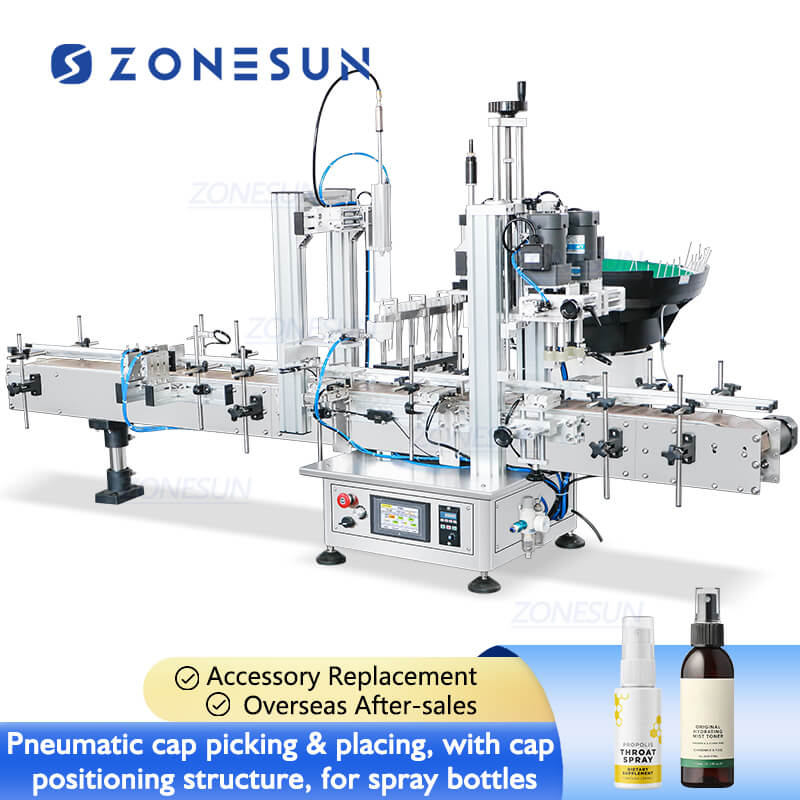
After evaluating the existing setup, our technical team proposed adding a second cap feeding and capping machine instead of replacing the entire packaging line.
The two machines could operate in parallel or alternate between production tasks, depending on the product and production schedule.
This arrangement provided an additional capping station and greater flexibility during SKU changeovers.
When one machine required adjustment for a different product, the other could remain available for production whenever the product routing and operating conditions allowed.
The upgrade addressed both the limited capacity of the original capping process and the interruptions associated with frequent product changes.
The Results: A 30% Long-Term Increase in Production Capacity
After the upgrade, the customer reported an approximately 30% increase in average production capacity based on actual production performance over an extended period.
A separate production test recorded an increase in operating speed from approximately 25 BPM to 35 BPM, equivalent to a 40% improvement during that particular test.
These figures represent different measurement conditions. The 30% figure reflects the customer's longer-term average production improvement, while the 25-to-35 BPM result comes from an individual production test.
The project demonstrates how adding equipment at a constrained production stage can improve production capacity without replacing the entire packaging line.
It also highlights an important point for high-mix manufacturers: flexibility involves more than handling different products. It includes maintaining production continuity while equipment is being adjusted for the next SKU.
How to Measure the Business Value of Packaging Flexibility
A flexible packaging line requires investment. Before purchasing additional equipment or replacing an existing system, manufacturers need to understand the financial and operational benefits.
Three areas deserve particular attention.
Calculate the Recoverable Production Time
Start with the time currently spent on changeovers.
A simple calculation is:
Daily Changeover Time = Number of Daily Changeovers × Average Changeover Duration
For the perfume manufacturer:
-
Daily changeovers: 3–5.
-
Average duration: 45 minutes.
-
Total daily changeover work: 135–225 minutes.
This figure provides a starting point for further analysis.
The next step is to identify how much of that time actually stops production. If some preparation activities take place while other machines continue operating, the full changeover duration should not be treated as lost line capacity.
Estimate the Annual Production Opportunity
Once actual recoverable downtime has been measured, manufacturers can estimate the additional production capacity.
Potential Additional Units = Recovered Production Minutes × Actual Sustained Production Rate
For example, if a factory recovers 30 minutes of genuine line downtime per production day and operates at a sustained rate of 30 packages per minute, the additional production opportunity is 900 packages per day.
This is a capacity estimate, not a guaranteed sales increase. Demand, material availability, downstream equipment, labor, and product quality all affect whether the additional capacity can be used.
Evaluate ROI and Total Cost of Ownership
The purchase price is only one part of the investment.
A useful evaluation should include:
| Cost or Benefit | Items to Include |
|---|---|
| Initial investment | Equipment purchase, installation, integration, training |
| Operating costs | Electricity, compressed air, consumables |
| Maintenance | Spare parts, servicing, replacement components |
| Labor | Setup, operation, cleaning, maintenance |
| Production benefits | Recoverable capacity, reduced waste, fewer interruptions |
| Business impact | Delivery reliability, inventory requirements, production flexibility |
A simplified ROI framework is:
Annual ROI = (Annual Net Benefit ÷ Initial Investment) × 100%
Annual net benefit should include only measurable savings and additional contribution after accounting for incremental operating costs.
For example, additional production capacity should not be valued as revenue unless the factory has sufficient demand and the ability to sell the extra output.
Total Cost of Ownership (TCO) provides a broader comparison by considering the costs of purchasing, operating, maintaining, and supporting the equipment over an agreed evaluation period.
Manufacturers should compare the TCO of upgrading selected machines with the cost of replacing the entire packaging line.
How to Evaluate a Flexible Packaging Line Before Purchasing
A supplier's claim that a machine supports multiple SKUs is not enough to establish its suitability.
Purchasing teams should evaluate the equipment against actual product specifications and production requirements.
The following matrix provides a practical starting point.
| Evaluation Area | Questions to Ask | Priority |
|---|---|---|
| SKU compatibility | Can the machine handle all required formats? | High |
| Changeover time | How long does a real format change take? | High |
| Change parts | Which components must be replaced or adjusted? | High |
| Recipe management | Can product-specific settings be saved and recalled? | Medium |
| Production speed | What sustained output is achievable for each SKU? | High |
| Machine integration | Can it connect to existing upstream and downstream equipment? | High |
| Cleaning requirements | What cleaning and verification steps are required between products? | Product-dependent |
| Maintenance | What are the maintenance intervals and spare-part requirements? | Medium |
| Future expansion | Can additional equipment or stations be integrated later? | Medium |
A Simple Supplier Evaluation Scorecard
Purchasing teams can use a weighted scorecard to compare proposals.
The following weights are illustrative and should be adjusted to the factory's priorities.
| Evaluation Criteria | Suggested Weight |
|---|---|
| SKU and format compatibility | 25% |
| Changeover performance | 20% |
| Sustained production capacity | 20% |
| Integration with existing equipment | 15% |
| Maintenance and service support | 10% |
| Expansion flexibility | 10% |
| Total | 100% |
Score each supplier from 1 to 5 for every criterion, where 1 represents poor suitability and 5 represents strong suitability.
Calculate the weighted score by multiplying each rating by its assigned weight and adding the results.
The highest score does not automatically identify the best machine. The scorecard helps structure comparisons, while technical testing and commercial evaluation remain necessary.
Questions to Ask Packaging Machine Suppliers
Before placing an order, manufacturers should ask suppliers to demonstrate the machine under representative production conditions.
Important questions include:
-
Which of our current SKUs can the machine handle without additional equipment?
-
Which change parts are required for each product format?
-
What is the expected changeover time between our most different SKUs?
-
Can product-specific parameters be stored and recalled through the PLC?
-
What is the sustained production rate for each product, rather than the maximum rated speed?
-
Can the machine integrate with our existing conveyor and control systems?
-
What adjustments are required when changing bottle, cap, label, or pouch specifications?
-
What tests will be performed during Factory Acceptance Testing (FAT)?
-
What maintenance, training, and spare-parts support are included?
Where possible, provide the supplier with actual product samples and packaging materials. A machine demonstration using the manufacturer's standard test materials may not reflect the conditions of your factory.
A Practical Implementation Roadmap
A flexible packaging project should begin with the existing production process, not with a machine catalog.
The following sequence helps manufacturers reduce investment risks.
Step 1: Map the Product Mix
List all current and planned SKUs, including container dimensions, filling volumes, closure types, labels, packaging materials, and special processing requirements.
Step 2: Measure Existing Production Performance
Record actual sustained output, changeover duration, startup losses, downtime, and rejected products for representative SKUs.
Step 3: Identify the Main Constraint
Determine whether the main problem comes from machine speed, mechanical adjustments, product feeding, manual operations, or poor coordination between production stages.
Step 4: Define the Required Flexibility
Decide which formats need to share equipment, which change parts are necessary, and whether parallel or modular equipment is justified.
Step 5: Compare Upgrade Options
Evaluate targeted machine upgrades, additional production stations, and complete line replacement using the same production requirements and TCO assumptions.
Step 6: Test and Validate the Configuration
Use representative products to check changeover procedures, sustained output, product quality, machine coordination, and operator requirements.
Step 7: Monitor Performance After Installation
Compare actual production results with the original baseline. Track changeover time, OEE components, output, quality, and maintenance requirements.
This process helps manufacturers determine whether the new configuration delivers the expected operational benefits.
Conclusion: Flexibility Should Match Your Product Mix
High-mix manufacturing creates a different set of requirements for packaging operations. Manufacturers must handle more product variations without allowing frequent changeovers and equipment adjustments to undermine production efficiency.
Flexible packaging lines address this challenge through adaptable machine formats, configurable parameters, interchangeable components, modular configurations, and standardized changeover procedures.
However, flexibility should not be pursued without a clear production objective. A factory with stable products and long production runs may benefit more from dedicated high-speed equipment. A manufacturer handling frequent SKU changes needs to pay closer attention to changeover time, equipment utilization, and production coordination.
The most effective solution is the one that matches the actual product mix and production schedule.
If your factory is introducing more SKUs or struggling with frequent packaging changeovers, our engineering team can help evaluate your existing production setup and identify suitable equipment configurations.
Contact our team to discuss your product formats, production targets, and packaging line requirements.
Related Reading
-
How to Reduce Product Changeover Time on a Packaging Machine
-
How to Scale Packaging Production Without Rebuilding the Entire Line
References
-
ISO 22400-1:2014, Automation systems and integration — Key performance indicators (KPIs) for manufacturing operations management — Part 1: Overview, concepts and terminology. ISO official standard page.
-
Wibowo, A. D. W., Fauzy, T. R., and Hadi, S. (2026), Production Process Time Reduction Strategy through SMED Method Implementation. The study reports a changeover reduction on a specific Flexo 8 packaging machine from 52.67 to 35.13 minutes. Journal article.
Lasă un comentariu