



How to Scale Packaging Production Without Rebuilding the Entire Line
Expanding production capacity does not always mean replacing an entire packaging line. For many manufacturers, the existing equipment still performs well, but certain production stages can no longer keep pace with growing demand.
A filling machine may become too slow for a higher output target. A capping station may limit the performance of the entire line. In other cases, frequent product changeovers, manual operations, or poor coordination between machines reduce actual production efficiency.
Instead of investing in a completely new packaging system, manufacturers can often increase capacity through targeted equipment upgrades, additional machines, and better production line coordination.
The key is to identify what actually limits output before deciding where to invest.

Identify the Actual Production Bottleneck
Before upgrading any equipment, manufacturers need to understand which part of the production line is restricting overall output.
A packaging line usually consists of several connected machines, such as filling machines, capping machines, labeling machines, and checkweighers. Each machine has its own rated production speed, but the entire line cannot consistently operate faster than its limiting stage.
Consider a liquid packaging line with the following rated speeds:
| Equipment | Rated Speed |
|---|---|
| Filling Machine | 60 bottles/min |
| Capping Machine | 75 bottles/min |
| Labeling Machine | 80 bottles/min |
| Checkweigher | 70 bottles/min |
In this example, the filling machine has the lowest rated speed. Therefore, the theoretical maximum line speed is limited to 60 bottles per minute.
Increasing the speed of the labeling machine would not solve the problem because the filling process would still restrict production.
However, rated speed is only a starting point. Actual output can also be affected by product characteristics, container handling, machine synchronization, changeovers, and unplanned downtime.
Manufacturers should evaluate sustained production performance rather than relying solely on the specifications listed in equipment catalogs.
Upgrade the Bottleneck Machine
If one machine consistently restricts production, upgrading that equipment may be the most direct way to increase line capacity.
For example, a manufacturer may replace an older filling machine with a higher-speed model while keeping the existing capping and labeling equipment.
Before making the replacement, several factors need to be considered:
-
Whether the new machine can handle the existing product and container specifications.
-
Whether its discharge speed matches the requirements of downstream equipment.
-
Whether the existing conveyor system can accommodate the higher output.
-
Whether the factory's electrical and compressed-air supplies are sufficient.
-
Whether the new equipment can communicate with the existing control system.
A higher-speed machine does not automatically increase the output of the entire line. Its performance depends on how well it integrates with the surrounding equipment.
In some situations, replacing one machine is enough. In others, additional adjustments may be necessary to prevent the next production stage from becoming a new bottleneck.
Add Parallel Equipment Where Necessary
When replacing the existing machine is not practical, adding another machine in parallel may provide an alternative.
This approach allows two machines to share the workload instead of relying on a single production station.
For example, a factory may install a second filling machine or capping machine to increase available processing capacity. Depending on the product and line configuration, the machines can operate simultaneously or take turns handling production.
Parallel equipment can be particularly useful when:
-
The existing machine cannot reach the required production speed.
-
Different products require separate machine settings.
-
Frequent changeovers interrupt production.
-
One machine needs maintenance while the other remains available.
-
The factory wants to increase capacity without removing functional equipment.
However, adding another machine requires careful planning. The conveyor layout, product distribution, discharge routing, and control logic must support the new arrangement.
The objective is not simply to install more equipment. It is to make sure the additional machine can contribute to actual production output.
Improve Material Flow and Conveyor Systems
Sometimes, the machines themselves are not the main problem. Poor material flow between production stages can also reduce overall efficiency.
For example, bottles may accumulate between the filling and capping machines because the downstream station cannot process them quickly enough. In another situation, the filling machine may need to stop temporarily because the labeling machine cannot accept incoming containers.
These interruptions can gradually reduce actual production output.
Improving conveyor design and material flow can help minimize unnecessary stops.
Possible adjustments include:
-
Adding buffer conveyors between machines.
-
Optimizing conveyor speed and bottle spacing.
-
Improving bottle transfer and positioning.
-
Adjusting conveyor curves and accumulation sections.
-
Adding sensors to control bottle movement and prevent congestion.
A properly designed buffer system can absorb short interruptions and allow upstream and downstream machines to operate more independently.
However, buffer conveyors cannot compensate for a persistent difference in production capacity. If one machine continuously processes fewer products than the preceding stage, the underlying speed imbalance still needs to be addressed.
Automate Manual Operations
Manual operations can become increasingly restrictive as production demand grows.
Some factories still rely on operators to feed caps, position containers, transfer products, or perform other repetitive tasks. These activities may be manageable at low production volumes, but they can become difficult to maintain when output requirements increase.
Adding automatic feeding, positioning, transfer, or inspection equipment can reduce the amount of manual work required.
For example, an automatic cap feeder can supply closures to a capping machine without requiring operators to place caps individually. Similarly, automatic bottle unscramblers can organize randomly positioned bottles before they enter the filling process.
Automation can help manufacturers:
-
Reduce repetitive manual handling.
-
Maintain more consistent product feeding.
-
Reduce interruptions caused by manual operations.
-
Improve production consistency.
-
Reallocate operators to other production tasks.
The appropriate automation level depends on the product, production volume, available space, and labor arrangement.
Not every manual operation needs to be automated immediately. Manufacturers should prioritize tasks that consume significant labor time or repeatedly interrupt production.
Improve Coordination Between Machines
Even when individual machines have sufficient capacity, poor coordination can prevent the production line from reaching its potential output.
For example, a filling machine may discharge bottles faster than the capping machine can process them. Without suitable accumulation space or coordinated control, the filling machine may need to stop repeatedly.
Improving machine coordination involves more than adjusting conveyor speeds.
The control system should manage communication between connected equipment, including:
-
Bottle detection and transfer signals.
-
Machine start and stop conditions.
-
Conveyor accumulation and release.
-
Product flow between different stations.
-
Alarm signals and fault responses.
PLC-based control systems and photoelectric sensors can help coordinate machine operation and reduce unnecessary interruptions.
Manufacturers should also consider whether the existing control system can accommodate additional equipment. In some cases, integrating a new machine may require changes to PLC logic, sensor positions, or operator interfaces.
Better coordination helps the entire line operate as a connected system rather than a collection of independent machines.
Check Whether Existing Utilities Can Support Higher Output
Increasing production capacity may also increase the demand for factory utilities.
Before installing additional equipment or upgrading existing machines, manufacturers should check whether the current facility can support the higher operating requirements.
Important considerations include:
Electrical Supply
Additional motors, heating systems, pumps, and control components may increase total electrical demand. The available power supply and distribution capacity should be checked before installation.
Compressed Air
Pneumatic cylinders, actuators, and automatic feeding systems often depend on compressed air. The air compressor must provide sufficient pressure and flow for all connected machines during operation.
Floor Space and Equipment Layout
Additional equipment requires space for installation, operation, maintenance, and product transfer. The existing layout should be reviewed to ensure that operators can access the machines safely.
Product and Packaging Material Supply
Higher output also means that raw materials, bottles, caps, labels, and other packaging components must be supplied at an appropriate rate.
A packaging line cannot maintain higher output if material replenishment or utility supply becomes the next production constraint.
*The best upgrade strategy depends on the actual production constraints of each factory. In some cases, increasing capacity does not require replacing existing equipment. A targeted addition at the right stage can improve both production flexibility and overall output. The following customer project illustrates how this approach works in practice.
A Real Customer Case: Increasing Perfume Packaging Line Capacity by 30%
A perfume manufacturer in Eastern Europe approached our team for help increasing the production capacity of its existing packaging line.
The factory already operated an automated packaging process covering bottle filling, cap feeding and capping, and bottle labeling. However, as the business expanded, its product portfolio continued to grow.
Handling more SKUs meant more frequent machine adjustments and product changeovers. The time spent preparing equipment for different products gradually reduced the time available for actual production. The existing line was no longer keeping pace with the manufacturer's production requirements.
Assessing the Existing Packaging Line
Based on the operating information provided by the customer, the existing line had the following approximate speeds:
| Packaging Process | Approximate Speed |
|---|---|
| Perfume Filling | 30–40 BPM |
| Cap Feeding and Capping | 25 BPM |
| Bottle Labeling | 30 BPM |
The cap feeding and capping process had the lowest operating speed among the three stages, making it an important area to address when evaluating overall line capacity.
However, machine speed was not the only issue. Different perfume SKUs required different machine settings, and frequent adjustments took up valuable production time.
The manufacturer needed a solution that could improve capping capacity while providing greater flexibility during product changeovers.
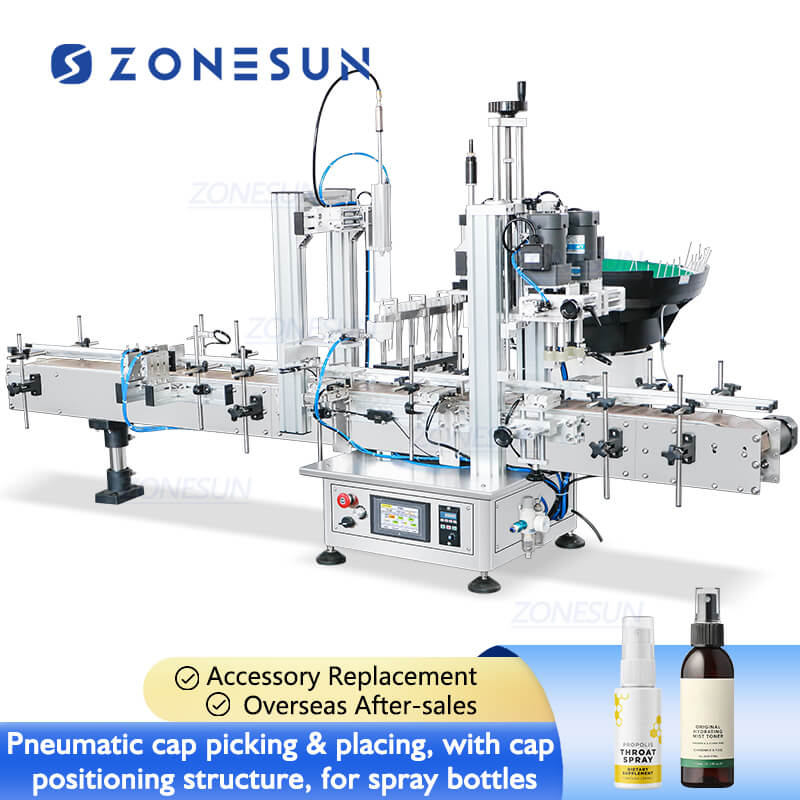
The Proposed Upgrade: Adding a Second Cap Feeding and Capping Machine
After evaluating the existing production setup, our technical team proposed adding a second cap feeding and capping machine to the line rather than replacing the entire system.
The additional machine provided another capping station that could work alongside the original equipment.
Depending on the production schedule and SKU requirements, the two machines could operate in parallel or take turns handling production. This flexible arrangement allowed the factory to adapt equipment usage to different production conditions.
For example, when one machine required adjustment for a different SKU, the other could remain available for production. This helped reduce interruptions caused by changeover work and allowed production activities to continue whenever the operating arrangement permitted.
The proposed upgrade therefore addressed two related challenges: the limited capacity of the original capping process and the production time lost during frequent SKU adjustments.
The Result: A 30% Increase in Overall Production Capacity
Following the upgrade, the customer's overall packaging line capacity increased by approximately 30%.
The improvement was not simply the result of adding another machine. The additional capping station gave the manufacturer greater flexibility in organizing production, while allowing machine adjustments and ongoing production to be managed more effectively.
Most importantly, the factory increased its production capacity without replacing the entire packaging line.
What Other Manufacturers Can Learn From This Case
This project highlights an important consideration for manufacturers with expanding product portfolios: production capacity depends on both machine operating speed and the time required to switch between products.
When frequent SKU changes become part of daily production, adding equipment capacity at the right stage can create more operating flexibility.
In some cases, a second machine may be a more practical investment than replacing an otherwise functional production line. The right solution depends on the actual bottleneck, the product range, and how the equipment will be used during daily production.
Final Considerations Before Expanding Your Packaging Line
Scaling production does not always require a completely new packaging system.
In many cases, manufacturers can achieve meaningful improvements by identifying the actual production bottleneck and upgrading only the equipment that limits output.
Replacing a slow machine, adding parallel equipment, improving conveyor systems, automating manual operations, and optimizing machine coordination are all possible ways to increase production capacity.
However, every upgrade should be evaluated in relation to the entire production process. A faster machine may simply move the bottleneck to another stage if downstream equipment cannot handle the additional output.
The most practical approach is to assess the existing line, understand the causes of production losses, and select upgrades that address the actual constraints.
For manufacturers planning to expand, a carefully designed upgrade can help increase output, improve production flexibility, and make better use of existing equipment without rebuilding the entire packaging line.
Leave a comment