
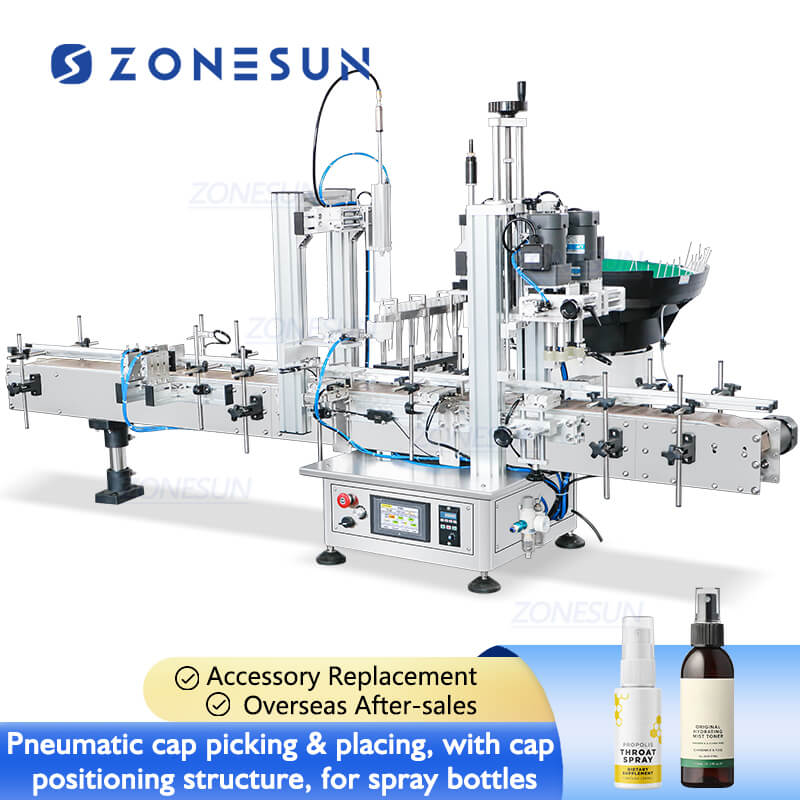


ZONESUN ZS-MD210 Automatic Inline Food Bottle Bags Conveyor Checkweigher Machine With Detecting Rejecting System
- One Year Warranty
- User Manual
- One-to-one Video Chat Support
- Install & Debug Video
- Custom Package Solution
- Local Service Location (Romania /Serbia /Kazakhstan/Mexico/Indonesia)
The ZONESUN automatic checkweigher inspects package weight continuously — bags, pouches, cartons, bottles, and other lightweight packages pass over a precision load cell, and any unit outside the preset weight range triggers the reject mechanism without stopping the line. Designed specifically for food, beverage, pharmaceutical, and daily chemical manufacturers.
To ensure accurate weighing, products must enter the weighing conveyor with sufficient spacing. For production lines where packages are closely spaced, ZONESUN offers an upgraded model featuring an extended conveyor with multiple bottle separation wheels. This multi-stage spacing system gradually separates products before weighing, providing more stable product intervals than conventional spacing mechanisms. The result is improved weighing accuracy, fewer false rejects, and more reliable performance on high-speed production lines. The machine connects inline with filling machines, packaging equipment, labeling machines, metal detectors, and cartoning lines — running as one inspection stage in a continuous sequence.
Automatic Checkweigher Parameter
- Machine Model: ZS-MD210
- Power Supply: AC220V 50HZ (60HZ)
- Rated Power: 0.15 KW
- Single Weighing Range: 1500 g
- Weighing Accuracy Range: ±0.2 g-±0.5 g
- Minimum Scale: 0.1g
- Conveying Speed: 30~100 m/min
- Maximum Speed: 160 pc.s/min
- Weighed Material Size: 300 mm (L)*200 mm (W)
- Weighing Platform Conveyor Belt Size: 400 mm (L)*210 mm (W)
- Product Size: 1522 mm(L)*560 mm (W)*1222 mm(H)
- Rejection Method: Push rod type/Swing Arm Type/Flip Plate Type/Air Blowing Type/Belt Sinking Type
- Control System: High-speed A/D sampling controller
- External Air Source: 0.6-1 Mpa
- Air Pressure Interface: 8 mm
- Body Material: SUS304
- Package Size:About 1350*920*1540 mm
- Package Weight: About 287 kg
*Specifications are for reference only and may vary by your product. Please confirm with us if required.




Touch screen control panel for more intuitive operation, it also has the data storing function.

Custom rejection method according to different kinds of products includes push rod type, swing arm type, flip plate type, air blowing type and belt sinking type.

The sensor can detect passing by products and separate products, it realizes automated production.

With 0.2-0.5g weighing error, this weighing checking machine is suitable for ≤1500g products.

Frequently Asked Questions
1. What products can this checkweigher inspect?
Pre-packaged food bags, pouches, sachets, bottles and boxes — snacks, coffee, protein powder, pet food, spices, dried fruits, frozen food, and similar packaged products. If it moves across a conveyor at a consistent spacing and holds a stable shape during weighing, the inspection system handles it.
2. What weighing accuracy can the machine achieve?
Up to ±0.5 g under stable conditions. The actual figure shifts with product weight, package stability, conveyor speed, and production environment — lighter packages and faster conveyor speeds both reduce the margin the load cell can resolve reliably. Consistent product spacing is what keeps the machine operating at the upper end of its accuracy range rather than the lower.
3. Can the reject method be customized?
Yes. Six reject mechanisms are available depending on the product format and line configuration:
-
Air blower — suited to lightweight bags and pouches where contact rejection would disturb adjacent packages
-
Flip plate — diverts packages by tilting the conveyor surface, suited to stable, flat-bottomed packages
-
Push type — a side-mounted arm sweeps packages off the line, suited to rigid boxes and cartons
-
Conveyor sinking — the conveyor section drops, allowing packages to fall through, suited to high-speed lines with consistent package spacing
-
Swing arm — a rotating arm guides packages to a separate lane, suited to fragile or irregularly shaped packages
- Lane separating rejector — divides the line into accept and reject streams, suited to multi-lane production
4. Can it be integrated into an existing production line?
Yes — inline operation is the standard configuration. The checkweigher connects with filling machines, pouch packing machines, labeling machines, metal detectors, carton packers, and other automated equipment, running as one inspection stage in a continuous sequence rather than a standalone unit with manual transfers on either side.
5. Why does this checkweigher use bottle separation wheels?
Weighing accuracy depends on the load cell seeing one package at a time. When products arrive too close together, the sensor reads the combined weight of two overlapping packages rather than each individually — which produces either a false overweight reading or a missed underweight, depending on how the overlap falls within the measurement window.
Standard bottle spacing mechanisms create separation through a single intervention point. For most products at moderate speeds, that's sufficient. For lightweight or unstable packages at higher production speeds, a single spacing point doesn't hold — products that separated correctly at the infeed close the gap again before they reach the weighing section, and the accuracy problem reappears further down the line.
The upgraded version addresses this through an extended conveyor with multiple bottle separation wheels. Rather than creating a gap once and relying on it to hold, the multi-wheel system maintains separation progressively across a longer approach distance.
The result: fewer false rejects, more reliable weight measurement at higher speeds, and a spacing solution that holds across a wider range of package formats and production rates than a single-point mechanism can cover.
Send the product dimensions, conveyor speed, and production capacity — the right spacing configuration follows from those specifics.